
There were certain things that always came naturally to Marley. When she was younger, it was hard to find a puzzle that stumped her for more than an hour; she always found the corner pieces first, never got tricked by the sea of blue sky, never missed where things fit together. In some ways, she prided herself on being able to see the whole picture before it was finished, to anticipate where the jagged lines would line up. This was a trait encouraged by her father, who never believed in letting things linger. “Rip the bandaid, Mare,” he always said, whether it was a bad grade in algebra or the day the dog died. Even when her mother left, he’d been brisk and unsentimental about it. “Some people just aren’t built to stay,” he told her, and it became Marley’s silent mantra, the way she braced herself for everything: expect the worst, survive the fallout, move on.So when her own life splintered, it was almost comforting to retreat into these inherited strategies, to treat each new crisis as a puzzle waiting to be solved. She didn’t shy from problems. In fact, she welcomed them, as if adversity was proof she was alive and in motion. She would face disasters head-on, no matter how raw or complicated the consequences. Maybe this was why, in the years that followed high school, her life developed a certain frictionless quality; she did what was needed, rarely hesitated, and moved through challenges like water through a pipe. She got herself a partial scholarship to the local college, stayed put while her peers scattered to distant campuses, and worked three jobs to keep ahead of tuition bills. She used her time at home as a buffer, an anchor; her room there was always clean, nothing left askew, and her laundry was always folded with military precision.Her relationship with her sister, Olivia, had always been a bit more complicated, but for all their differences, the two rarely fought. Olivia was wild and impulsive, always running toward the next good time, the next thrill, the next disaster waiting to happen. Marley, in contrast, was a master of self-restraint. She kept her ambitions on a tight leash, preferred the comfort of the known, and rarely placed herself in situations where the outcome was unpredictable. Yet for all the ways Olivia exasperated her, Marley couldn’t help but feel protective, as if it was her solemn duty to keep her older sister from completely unraveling. And so, when Olivia’s college romance with Matt came to its abrupt, catastrophic end, resulting in a surprise pregnancy and a hasty move back home, Marley didn’t flinch. She simply cleared out space in the hall closet for baby supplies and got to work.Cristian arrived one spring afternoon, small and wrinkled and entirely dependent on Olivia, who proved much less equipped for motherhood than she’d imagined. Matt, predictably, was less than present. He visited sporadically, always with flowers and an apologetic grin, trying to make up for lost time with expensive toys and loud declarations of affection. Olivia alternately loved and hated him for it, but Marley remained unimpressed. She saw the cycle for what it was: Matt would show up, play Dad for a weekend, then disappear for two months—repeat as necessary, until Cristian was old enough to notice or Olivia moved on to someone new. Marley made herself available for the intervals in between, stepping in with bottles and diaper changes and the kind of steady, unsentimental care that came easily to her and no one else in the family.And then, inevitably, everything shattered.The night it happened, Marley had been in charge of Cristian. Olivia had a date, her mother was out of town for work, and her father was—well, no one ever seemed to know exactly where he was, but it was never here. Marley didn’t mind babysitting, except for the crying. Cristian was a sensitive baby, and his wails could flatten her most resolute nerves in seconds. That night, he was inconsolable. She rocked him, bounced him, sang old TV jingles in desperation. Nothing worked. By the time she figured out he was hungry, it was nearly ten, and the only can of formula in the house was achingly empty. Marley spent a good fifteen minutes scouring the cabinets for any sign of a backup, but her search turned up only dusty cans of soup and a forgotten bottle of tequila from her mother’s last “girls’ night in.”With no other options, she bundled Cristian in his car seat and headed to the twenty-four-hour pharmacy on the edge of town. The baby screamed the entire drive, turning a shade of red Marley had previously assumed was exclusive to cartoon characters. She played the radio at full volume in a futile attempt to drown him out, and when that failed, she simply gritted her teeth and counted the blocks to the next red light. “Cris, please,” she begged the rearview mirror, “just give me one minute.” She was surprised to hear herself pleading, her own voice raw and unfamiliar, as if the night had pulled something out of her she didn’t recognize.After that, things went dark. She remembered the glare of headlights in the rearview, the sickening lurch of metal, the distant sound of someone screaming. Then nothing, not really, not until she was in a hospital bed and a nurse was gently explaining the concept of “next of kin.” Her family filled in the blanks for her—drunk driver, rear-ended at the intersection, Marley was lucky to escape with nothing more than a concussion and some bruises. Cristian, however, had not survived. “Instant,” her father said, as if that would somehow comfort her. “He didn’t feel a thing. Just went right to sleep.”The weeks that followed blurred into a single, undifferentiated ache. Marley stayed in bed most days, refusing to eat, refusing to answer texts from Olivia or anyone else. At some point, her father showed up and physically lifted her into the shower, telling her, “You can’t hide from this, Mare.” She tried to explain that she wasn’t hiding, merely waiting for her body to catch up with what had happened. But he didn’t understand, not really, and neither did Olivia, who grieved loudly and publicly, as if volume might drown out the reality of the loss. The funeral was a small, tense affair. Marley almost didn’t go. Her father practically dragged her across the parking lot, fingers digging into her elbow. When she entered the chapel, the room fell silent, every set of eyes instantly trained on her. Olivia’s glare was ice-cold: “What are you even doing here?” Marley didn’t blame her. She wondered the same thing herself.Afterwards, Marley did what she always did when the puzzle became too much: she found a new corner piece and started over. She left her college program, used what little was left of her savings and inheritance to rent her late grandmother’s house a few towns over. The place had stood empty for years, dust collecting on every horizontal surface, cobwebs slung between the ceiling beams. Marley didn’t mind. The silence was a relief, the isolation a kind of balm. She spent the first week cleaning—scrubbing the floors, bleaching the bathrooms, airing out the closets. It was almost meditative, the way she worked until her arms ached, then collapsed on the bare mattress and let the exhaustion blur her thoughts.By the third week, the house felt almost hers. She’d moved in a battered loveseat and a cheap IKEA bookshelf, but most of the rooms remained empty. She found herself gravitating toward the kitchen, the only space that didn’t echo when she walked. Sometimes she would stand at the counter, running her fingertips over the worn tile, and try to remember what her grandmother’s voice sounded like. She’d spent so many summers here as a child, but the memories were slippery, refusing to coalesce. Mostly she remembered the way her grandmother’s hands moved—chopping onions, shuffling cards, folding Marley’s hair into crooked braids. It was strange to think that now, she was the only living thing in the house.There was one friend who kept in touch, though. Jess, from one of her mandatory college courses. She was loud and unfiltered and the only person who didn’t treat Marley like she might shatter if handled incorrectly. Jess called every few days, always with the same greeting: “So, still alive?” The last time they spoke, Jess had been three glasses of Rosé deep and entirely unguarded. “You’re being weird, Mare. You gotta let yourself heal sometime.” Marley tried to laugh, but the sound caught in her throat. “I’m fine,” she lied, “just taking a break from people.” Jess didn’t buy it, but she let Marley have her space. “Just promise me you won’t become one of those people who talks to themselves and hoards cats,” she joked. “Promise,” Marley said, though she knew it was only half a joke.And so the days unspooled, one after another, each more monotonous than the last. Marley settled into a routine—wake up early, run three miles along the river, work on freelance editing gigs for a few hours, then lose herself in mindless chores. She avoided the east wing of the house, where the guest bedrooms were. She couldn’t say why, exactly, except that she didn’t want to see the empty spaces, didn’t want to be reminded of all the things left unfinished. In the evenings, Marley made a ritual of sitting on the wooden porch steps with a chipped mug of tea, watching the sky bleed into colors she never saw in the city. She liked the way dusk painted the house in shifting blues and purples, the way the wind carried the scent of old trees and tilled earth. Out here, the dark came in slow and deliberate, not like the abrupt blackouts she remembered from her childhood home, where streetlights flickered on before the sun had even finished setting. In her grandmother’s house, the approach of night was an event, an unhurried negotiation between the day and whatever came next.Marley found herself lingering in those in-between hours, soaking in the hush that settled over the property. She’d wrap herself in an old cardigan, legs folded under her, and listen for distant sounds—sometimes the low rattle of a truck on the highway, sometimes just the cricket chorus and the creak of settling wood beams. The absence of human voices was jarring at first, but she’d grown to crave the quiet, to let it seep into her skin until she felt almost translucent. There was a heaviness to it, too, but the weight was different from what she’d carried before. It didn’t press her down; it just kept her from floating away.Sometimes, if she sat still long enough, her mind played tricks on her. She’d think she heard a child’s laugh from the yard, or the soft thud of footsteps behind the screen door. Once, she caught herself whispering goodnight to the porch swing as it rocked in the breeze. She supposed this was how loneliness advertised itself—not with grand gestures, but with these tiny, persistent echoes.Tonight, as the first stars winked through the indigo overhead, Marley closed her eyes and tried to remember what her life had been like before the accident. She could summon fragments—a birthday cake, her sister’s perfume, the sound of Cristian’s bottle clinking on the countertop—but the details were slippery, prone to dissolving around the edges. She wondered if it was possible to forget something on purpose, to will a memory into obsolescence through sheer repetition. Maybe this was healing, or maybe it was just cowardice.The porch boards were cool beneath her, and the mug steamed faintly in her hands. She sipped, letting the silence fill her up, letting it expand until it pressed gently against her ribs. For a moment, she felt the shape of her own sadness, not as an enemy but as a companion—something familiar and always there.
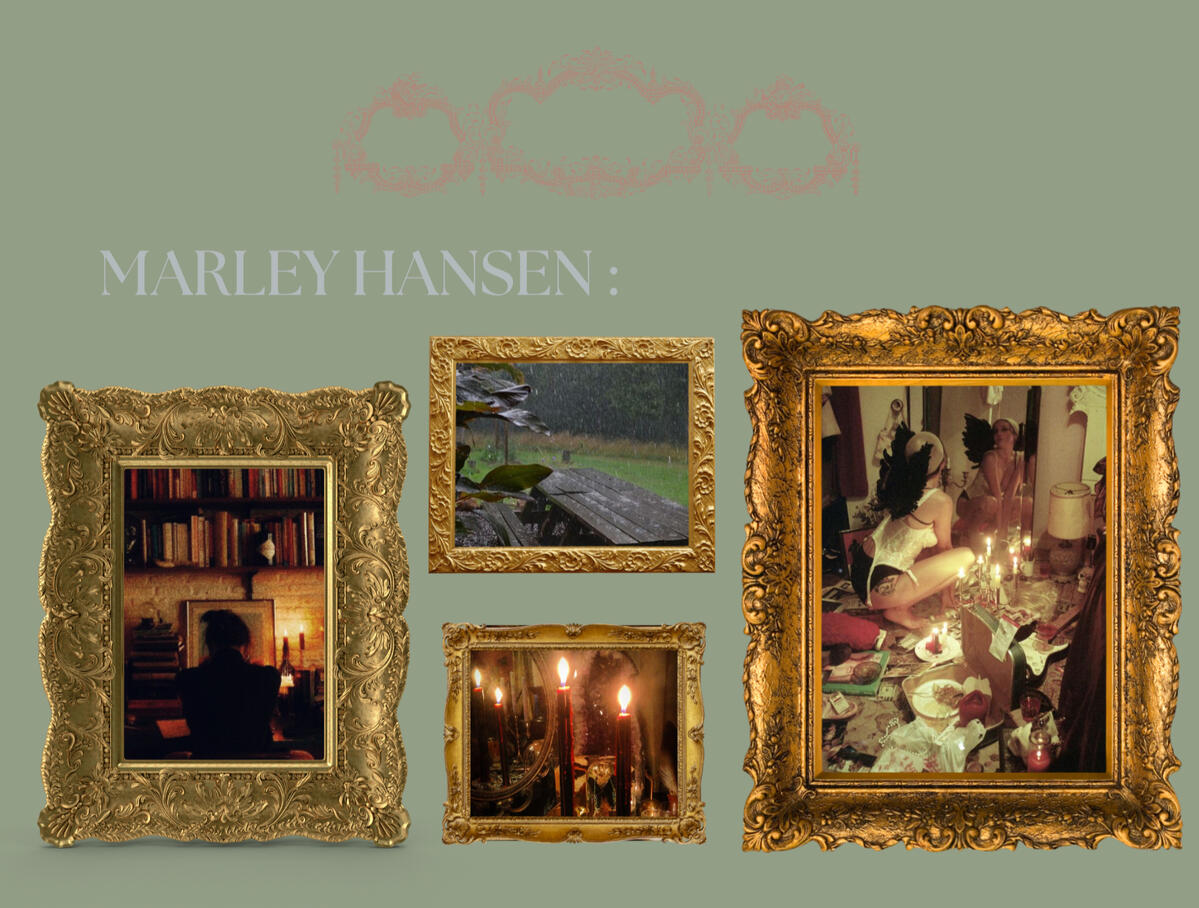
Marley is twenty-two, five foot six, with the kind of thin frame that makes her thicker legs look like an afterthought—a pleasant one. Her waist curves just slightly before widening at the hips. Her chest is flat. Her hair is a light brown that goes almost golden in direct sun, and it falls over her shoulders smelling faintly of lavender. Her cheekbones are soft, her jawline gentle, and her freckles scatter unevenly across her nose and cheeks the way they do on people who spent their childhoods outside.
Her eyes are brown and long-lashed, and her lips are the kind that look slightly parted even when they aren't.She is the sort of person who notices when someone hasn't eaten. Who will quietly refill your glass before you ask. Who will stay late. She is an introvert in the truest sense—not shy, exactly, but someone who returns to solitude the way other people return to food or sleep, needing it to function.She has a nephew named Cristian. Had. He was in the backseat when a drunk driver ran a light and hit them on the passenger side. Marley walked away. Cristian did not. She has replayed the moment of impact so many times that it has started to lose its edges, going soft and strange the way a word does when you repeat it too long. She takes antidepressants now. She questions, with some regularity, whether she deserved to be the one who walked away.